Showing posts with label 1987. Show all posts

Monday, April 27, 2020

Dieting, and an August 5, 1987 card

I had a little book with lists of food and the calories they contained. This was back in the days before everything you ate had nutrition information and there were no digital means to track your fitness or eating. Every morsel that I put in my mouth was written down in a notebook with a calorie total next to it. If I wavered in my devotion to this irksome task, a picture of myself at my most rotund had been pasted into that very same book as well.

After two years of this sort of recording, I started to relax a bit in my eating, but not in my exercising. I had started to play racquetball for up to two hours with whatever willing opponents I could find and allowed for the occasional pizza or cheesecake to creep into my routine. I did this less because I couldn't bear banishing these treats from my life than out of a desire to be a "normal" person who ate these types of things. I managed to do this and still continue to lose weight, though I did panic when I got sick and couldn't burn more calories with copious amounts of exercise.

I had an eating disorder during my childhood and young adulthood, and I swapped it out for a different type of disordered behavior in college. Instead of compulsively eating, I started compulsively exercising as fear of not continuing to lose weight and to eventually be physically rejected by Tito when we finally met face to face gnawed at me.

I wrote this card from a Pizza Hut and it wasn't the first or last time that I talked about what I "indulged" in and how I was going to rein myself in later in compensation. I often felt that I had to prove to him that I wasn't going to return to my former weight by explaining such adjustments.


Monday, April 13, 2020

August 4, 1982 letter

When I compose these posts, I go through my files of scanned correspondence, find one that I want to share, and read it until a story or thought relating to that letter, card, or photo pops into my head. I then share that store and the scan. Recent events (the pandemic) have made it nearly impossible for me to bring up my old memories from the past and I haven't posted stories because I've been (unsurprisingly) eaten up with anxiety and fear. However, I don't want to stop sharing materials related to my book because I'm blocked about background stories so I decided to just share without an accompanying story sometimes. I'm hoping this will  help me get back on track. I hope you're all safe and well, and we can all get through this together.

Today, I'm sharing a letter which was written during the time period in which Tito had just moved to Japan and was training in Okayama. This was a time period in which he couldn't receive my correspondence (as he was there temporarily and would move to Tokyo when his training was done). I was used to lavish attention from him as our long distance relationship started and his time to leave the U.S. neared, and then there was mostly silence. This was a shock to my system, and this letter reflected that.


Monday, March 30, 2020

"Clothes Horse", and a 1987 photo

"You're turning into a clothes horse!" My mother said this after I put on my newest outfit. She had spent all of my life trying to get me to like clothes including treating every Easter and new school year as a happy time in which she "gifted" me with new togs. When I was fatter and younger, I hated clothes and had no interest in them because nothing looked good on my body. Now that I'd lost weight and looked better in them, she was criticizing me for being too interested in them. Such was the pattern with my mother who made sure that, no matter what I did, I was always failing.

This is the first picture of me that I sent to Tito. It was also the most adventurous piece of clothing that I ever wore in public as it was woven with gold threads throughout the "jacket" and "culottes" at the bottom. It was actually one integrated piece and a pain in the ass for going to the bathroom as it had to be pulled off entirely like a swimsuit. Still, I loved wearing it with black tights and felt I looked pretty good in it. When Tito got this picture, he didn't notice my clothes. Rather, he noticed how sparse my KISS pictures were on my wall in comparison to Aida and Jo who wallpapered their walls. I had plenty of posters, but I didn't like the "wallpaper" look and intentionally chose more space between my pictures.


Wednesday, March 18, 2020

Being Organized, and a July 30, 1987 greeting card

At some point around my 20th birthday, my mother bought me a file cabinet. It wasn't like a typical office cabinet as it only had one compartment on top for files and a shelf below it. The top held hanging file folder and was beige. The bottom was dark brown and was where I could store random books or other items that were too bulky to be stored in file folders. It had a locking top, though I rarely felt the need to secure it.

I doubt many young adults wanted a file cabinet for their birthday, but I did. I became very organized from a young age which helped a lot when it came to my expanding and expansive KISS collection. I had more posters than my walls could accommodate and had a system for keeping the extras in tubes in a manner that allowed me to easily locate the ones I wanted when I was ready to "redecorate" by swapping them around.

Despite my high levels of organization, I sometimes lost track of things. I think this was down to having more volume and less about a failure on my part to keep things in order. The card that I'm sharing today was one of those things that I lost, then found again. It wasn't unusual given the staggering amount of correspondence that I produced for things to be set aside and forgotten, then discovered and completed.


Friday, March 6, 2020

Cats, and two photos

Our basement was a concrete bunker, and not the good kind that you can live in if civilization falls or zombies rise up to eat the earth. It was dank at best, and sopping wet, moldy, and gross at worst. When I was a child and forced to go down there to do laundry, I was scared of the dark, little room on the left that used to house our winter supply of coal and was now housing a healthy pile of slag. I was less frightened of, but not a fan of the little room on the right with shelves that held suspect jars of canned food that my mother was given on occasion. Mice favored that room, and I did not favor them back.

The only benefit of that space was that we could keep our cat litter box down there so it wouldn't stink up the rest of the house. The dogs' peeing and pooping on our carpeting had to carry the burden alone in that respect. We had to keep the door between our dining room and basement cracked open at all times to allow the cats free access to their toilet and this worked fine when the weather was inclement to varying degrees. When it grew warmer, and we left the door to the back yard that led into the basement open so dankness would dry out and become less prone to mildew, things got complicated.

One of my cats, a calico named Zee (technically and confusingly spelled Sie as the name was German), was a world-class hunter. As I explained in the letter I posted a several days ago, this would result in general carnage strewn about the house. I would have taken mouse guts and rabbit heads over the worst of her transgressions one summer day.

Zee brought something up the steps through the basement that was nearly as big as her and quite dark. We were accustomed to seeing her drag some poor animal into the house on a regular basis so this wasn't a huge deal. It was almost funny looking at what she had and guessing what she'd caught this time. "This time" though, it was a black snake which was not as stunned as her usual prey. It was very much alive and she dropped it in the living room.

Like no small number of people, I am very frightened of snakes and I freaked out. My mother said it wasn't a poisonous snake so there was no reason to be too worried, and she was probably right because more than  90% of snakes aren't venomous or dangerous. However, the human brain is designed to be "wrong" in this respect because there is no penalty for being so. It's why we're scared of things in general categories rather than as specific entities.

My mom took matters in hand because I was too paralyzed to act. She cornered the snake (which was looking to escape under the couch) and whacked it with her shoe. The inert snake was then offered back to Zee so she could carry on in her usual manner, but she lost interest in it now that it was dead. These were the cats of my world.

Tito had a cat, too, but his never hunted anything or presented any animals for his inspection. His cat was cuddly, sweet, and prone to meowing a lot. Mine were partially feral hunters who preferred the great outdoors to my petting them. They'd occasionally pee in my bed, but they didn't have that much use for me in general. Somehow, even our pets separated the types of lives we lived even when they were the same animal.

Like sands through the hourglass, these are the cats of our former lives:


 Zee on my bed, on a day when she hadn't urinated on it.


 Zee eating what I provided her, and what she provided herself.

Tito's cat, Malachi, having a yawn.

Thursday, March 5, 2020

Patience, and a July 28, 1987 greeting card

I was six years old and crying in bed when I was supposed to be going to sleep. My mother walked in and asked my sister what was wrong with me. She said, "She's upset because she wants that doll." I had discovered a black Barbie doll named "Christie" and I felt that I had to have it immediately or that it would be the end of the world. That was the first and last time I can recall sobbing in desperation and impatience for a material object that I felt I would never have. Several months later, my mother did get me that doll for me despite the relative expense. She was my first and only Barbie. I remember being so happy to finally get what I wanted and was in love with that doll for quite some time.

I have never been a patient person as indicated by that anecdote from my childhood. I literally felt pain when I had to wait for something I desperately wanted. While I have managed to expand my ability to wait as the years have gone by, I was less capable of managing my feelings at 22 when I got into my long distance relationship with Tito than I am now at 55.

Part of the ying and yang of impatience is that it can be highly motivating as well as emotionally draining. My way of managing it was to analyze the circumstances I was in and to construct as many emotional bridges and connections to Tito as I could. Much of my early correspondence reflects this, and much of my later correspondence reflected my resolve crumbling and reforming.


Monday, March 2, 2020

"Inappropriate" work conversations, and a July 27, 2987 letter

As I read back through this letter, I had a few thoughts. The first one was that the conversations at work that I talk about here would never be permitted in the present cultural environment in America. My boss would be in a huge vat of boiling hot water for saying the things he said to two female employees at that time. The second thought I had was about why we talked so much about sex at my former workplace. For my part, I think it was because it wasn't something anyone had ever talked to me about before and made me feel more included with the group. It's also likely that, given how out of reach nudity and pornography were at that time compared to the present, it was more taboo and therefore more interesting.

This letter was one of those times when I recounted things that happened in my life in detail to Tito so that he had a better understanding of how I spent my days. It helped him inhabit my reality, which I was only to learn many years later was hardly typical for most people.


Sunday, March 1, 2020

Postage Shock, and a photo from August 1987

My first package to Tito after he started work in Japan contained the usual assortment of tapes. The main difference was that it had a long and confusing address which I checked again and again to make sure I'd copied it correctly. It was addressed to his school's office since I didn't have his home address yet.

Both of us knew that our postage costs were going to increase after our long distance relationship changed from transcontinental to international, but I had no idea how much more it would be. I handed my padded parcel over the the nosy postal workers and they weighed it up. It would have cost $2-$3 if I'd sent it to California. They charged me $20 to send it to Japan. (Note: In 2020 dollars, that's $45 for one small package.)

I told Tito in my next correspondence that I didn't know how often I could tape him with that sort of price tag. He came back and said, "Don't you know about "small packet"? I had no idea what that was, but the mail bitches who read my mail and vexed me so didn't mention it when I asked them if there was a cheaper way to send my package.

In the end, I had to educate the workers at our small town post office about small packet rates. They argued with me at first, and I asked for a rate chart. In the end, they sighed as if I were imposing a great hardship on them and acquiesced after I'd pointed out the existence of this much lower rate.

Tito sent me a photo of himself mailing a small package (via "small packet") to me from his local post office once he had settled in Kitasenju. Fortunately for him, the Japanese postal workers were far more knowledgeable and polite.


Wednesday, February 26, 2020

Imagining, and a July 26, 1987 greeting card

"We think of ourselves as floating outside of our bodies...big heads just floating outside," said Mary. She stood at the front of a graduate school classroom in chunky heels and layers of old-lady clothes. She was chubby, talked a lot, and loved to tell embarrassing stories about her clients when the students laughed. I found her sharing stories about clients with substance abuse issues urinating themselves while their mortified family pretended nothing was wrong as part of her comedy act in poor taste and questionable ethically.

What Mary was trying to say in an inelegant way was that we often perceive ourselves as a conscious entity that exists separately from our body. The real "me" isn't locked into a meat sack, but exists in the ether. When we think about being loved, we want people to love that body-less self—what some might call a soul.

I spent most of my life feeling separate from my body because it was something that I mentally wanted to push myself away from. It was a prison that I was trapped in, not "me." When I fantasized about being loved by someone, I couldn't put myself in the picture. I had to inhabit another role, another body, another person. I was an actor playing a part in my own fantasies because I couldn't bear to see "me" as being with the body I was in.

I wondered if Mary, who was physically unattractive, talked about this mind-body disconnect because she also wanted to distance her sense of her consciousness from her physical body. I had read her book in which she had had a meltdown because she was in love with her partner in her therapeutic practice and he didn't want her back. She spoke with disdain about a woman "in a sparkly tube top" who interviewed for a clerical role that this man fell in love with. It was clear that she felt he loved a body, and not a person because she would have been his choice had he been less shallow.

Given my experiences with Mary in the class that she was teaching, I think she overestimated her appeal on a psychological level. She admitted she had attention issues, and she did. When she was in the room, she had to be the one speaking and the center of attention. She was also prone to crying and having mini-fits any time a student disagreed with her and had one big meltdown in front of us. With that sort of emotional manipulation and lack of control, I'm not sure her partner would have found her appealing spiritually either, but Mary imagined she was much better than "the woman in the sparkly tube top," who she felt was unworthy of even having a name and Mary reduced to an object.

When I lost weight and felt more in tune with my appearance—though I never entirely got there—I felt more aligned with my physical presence, but I still struggled to imagine myself in the picture as a corporeal entity. It didn't help that the "me" that Tito fell in love with at a distance was actually pure personality. Unlike most relationships, he really did fall in love with my conscious self as I did his.

Once we declared our feelings and made a commitment, I had to make purposeful efforts to align my thinking with the idea of being physically in the relationship as well. This was the hardest part for me given my body image issues and fears about physical rejection. It was an act of will to see myself as a (relatively) "normal" person in this way since every "relationship" I'd ever entertained in my mind to that point was my mind in an imaginary person's body living that person's life.

This card was a part of the process of pulling the physical "me" into the relationship with the conscious "me." (Note: this previous note pages on Calvin Klein stationary were included in this card, which is why every square inch isn't scribbled all over with words.)


Monday, February 24, 2020

Envy, and a July 26, 1987 note (partial)

Linda's house felt large and threadbare. It was clean and tidy, but the years had left the bare boards looking weathered and worn down. It had been built many decades ago, but had never had any updates to the interior. I dropped by her place to pick her up so we could drive about 45 minutes to a mall that included one of my favorite targets of sarcasm, "Big Lots." Linda didn't have a car or much money so these sojourns were a good way for us to spend some time together without breaking either of our small banks.

Linda's hair was black and nearly straight. She usually had it cut it into a mid-length bob and wore jeans  and a polyester shirt in a plain color. She was of average weight, but she fretted about her "thunder thighs" and told me that she feared she'd have the thick, wavy legs that she saw on her mother. She was well-groomed, but quite plain. This was in contrast to me who, at that time, wore elaborate make-up and dressed to the nines.

As we made the long trek to the mall, Linda said something no one had ever said to me before and I have not heard since. She said, "I was jealous of you when we were kids." Since I had grown up poor, fat, bullied, and abused, I was stunned to hear her say this. As a fellow child of an alcoholic who knew my circumstances better than any other outsider, I couldn't fathom what would compel her to feel that way.

When I asked her why, she told me that my mother was always "so nice" and that she was always buying my sister and me things. It was true. On a material level, my mother did go over the top for us. She not only bought a great many toys and other items during my childhood, but when I was older and became a KISS fan, she'd march into record shops and ask them to hand over free promotional items. I was too embarrassed to ask, but she was incredibly bold. However, she did emotionally abuse her children until their sense of self-worth was reduced to nothing. I told Linda that the face my mother showed her was not the only one she possessed, but I could tell that she didn't believe me.

Linda told me that her mother had also expressed envy of my mother and this further shocked me. My parents fought all the time and my dad frequently stormed out of the house after arguments and hung around in bars until late at night. She told me that her mother felt that way because my dad was on disability whereas her family was on welfare. They got less money from entitlements than we did and had to live with the indignity of food stamps. Her father also sometimes physically abused her mother whereas my parents limited their abuse to words.

My conversation with Linda opened up a window on a perspective that had been tightly shut before. As bad as my life circumstances were, there were still others who had it worse. The level of hardship I endured was a matter of perspective. Since Linda wasn't bullied daily at school and could be average and invisible, I always saw her as better off than me, but she saw me as smarter, better loved, and more materially wealthy than her. Both of our views were informed by incompleteness though. She only saw my advantages and I only saw hers.

I had more fun with Linda in my childhood than any other friend and I tried to carry on that relationship into my adult life. Our infrequent trips to "Big Lots" and other types of shopping stopped when she had a baby and didn't have time to venture into the world with me anymore. By the time Tito came into my life, Linda had largely exited it so she is rarely mentioned in any of my correspondence with him, but "Big Lots," which I connected with spending time with her, was still there.


Sunday, February 23, 2020

Psychological Teddy Bears, and my first cassette to Tito

When I was in 6th or 7th grade, my aunt and uncle were crazy about Elvis Presley. They spoke excitedly about seeing him in concert during what had to have been his last years of performing before his death. I questioned how people could be so wrapped up in someone who had become famous in the 50's and 60's.

It wasn't just that they liked his music. They were middle-aged people enthralled by what I saw as an "old guy" (in his 40's) who wasn't producing new music anymore. I felt like they were watching re-runs rather than something new.

By the time I was 22, I  had my answer as to why this happened because I had been a KISS fan for 10 years at that point in time and continued to be one. The  band was less successful, less interesting (as they had taken off their make-up and were performing in rags), and their music was less impressive. In many ways, I didn't even like the band anymore as they seemed to have transitioned from exotic performers in kabuki-style make-up with distinct personas to a generic hard rock band.

As I talked to Tito on my first tape to him, I told him that the band was like a teddy bear to me and to other fans. Jo and I had discussed it and what we realized was that being a KISS fan was so woven into our identity that holding onto our fandom gave us security. We couldn't let go of it because it meant losing a piece of ourselves.

At some point in time, many years later, I realized how having your identity connected to something external to you was a dangerous thing. It opened me up to disillusion and disappointment, but it also sucked the joy out of life to remain psychologically shackled to something just because embracing it was a small comfort due to its familiarity. I let KISS go completely, sold my collection, and moved on.

It wasn't easy and part of me kept wanting to run back to my fandom so that I could find the piece of me that I felt was attached to it. In the long run, the experience of releasing my attachment to something which defined me for the longest time prepared me to let go of other things I once enjoyed, but no longer did. I learned that it was only after walking away that I could find new facets of myself through embracing other interests. It was psychologically like clearing the shelf of old objects which no longer made me happy to make space for new ones.


Friday, February 21, 2020

Student Assistants, and a July 26, 1987 note

The student assistants worked in a fairly industrial-looking room with a handful of old command-line computers and a huge printer. The printer we had been using required paper with strips on either side with holes punched in it to guide the feed. After a page was printed, you tore the strips off using perforated edges. It had one font, and printed a bit lightly, but otherwise served us well.

One day, a new Macintosh was delivered alone with a fancy printer with a daisy wheel that could print pages on plain paper and in a limited variety of fonts. I took little notice of it as I was more interested in efficiency with my tasks than novelty, but the other assistants including a slim young woman with medium-length dark brown hair gathered around it in intrigue. The dark-haired woman in particular seemed to fall in love with the new set-up and spent hours working with it much to the consternation of  the other assistants who wanted a crack at it, too.

A few weeks after the new printer arrived, I was told that it was broken and that the young woman who had formed the strongest relationship with the psychology department's new technology was responsible. I thought she had just used it to the exclusion of all of the older, sturdier equipment, but it turned out that she was using it to produce personal correspondence.

The oldest assistant among us, a chain-smoking guy with floppy light-brown hair who tended to pace nervously around whatever space he was in, told me that she was making form letters to send to her friends back home. She would ask a question and provide what she thought were funny, interesting, or quirky multiple choice answers for them to check off and return to her. After the umpteenth letter, the daisy wheel on the printer pooped out and she was barred from touching the new technology. While everyone was angry with her for breaking the new gadget, I felt sorry for her that the only way she could get her friends to write back to her was to give them a form letter.

I was far too verbose to use this sort of letter-writing, but my mother bought me a tablet full of the same check-box style correspondence. If you look at the note I'm showing today, you can see a line across the top where it was torn off the page. This was the first and last piece of written correspondence of this type that I sent to Tito. Most of what I did was covering nearly every square inch of space I had with words.


Wednesday, February 19, 2020

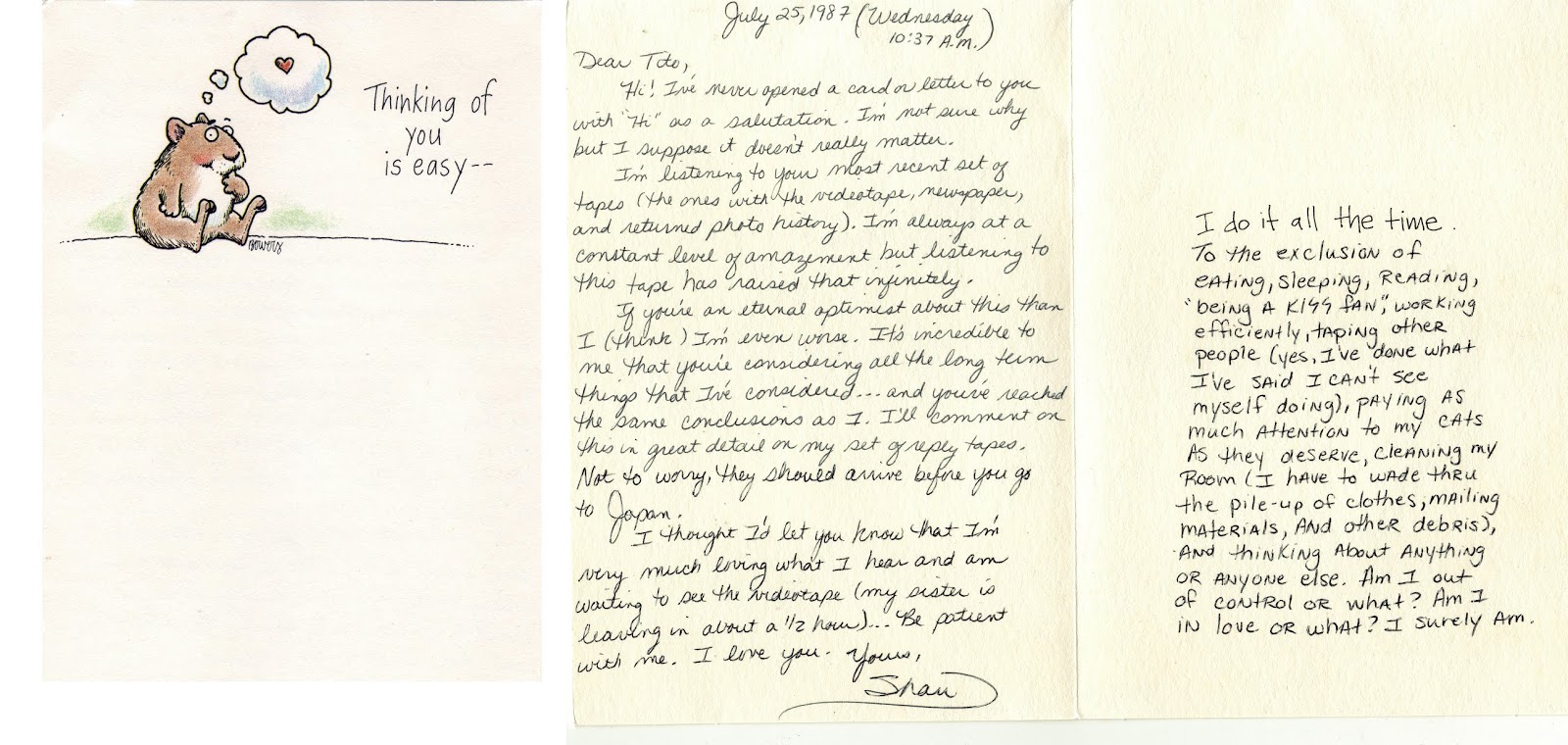
Hugs, and a July 25, 1987 greeting card

I was sitting on the bleachers in our school's gymnasium. It had been converted into an "auditorium" by pulling the seating, which could be pulled out and pushed back like the bellows of an accordion, away from the walls. My class of 1982, which had exactly 82 graduates after the drop-outs and failures, was waiting nervously for commencement ceremonies to start.

Valerie walked up behind me and embraced me around my shoulders for a warm hug. A short time before this moment, I'd awkwardly given her a silver identity bracelet as a graduation gift. It had been a "hit and run" present because I lacked the social skills to remain present with gratitude. I sat there feeling like I'd successfully escaped any emotional displays when she hugged me.

Val had been my best friend for the last three years of high school. She was beautiful with long, straight, brown hair and big brown eyes. Her figure was nearly perfect in a voluptuous way with large breasts and hips and a small waist. Her physical attractiveness wouldn't have been so remarkable if she hadn't been so kind to me. Most of the pretty people didn't want to have anything to do with me, but she talked to me when few others would. She also gave me the first hug I could remember.

While I'm sure that my parents likely hugged me on occasion as a very small child, it happened outside of my conscious memory. No one in my family was comfortable with any sort of touching and my father was especially resistant to showing physical affection to his daughters. As a result, when Valerie embraced my shoulders from behind, I was frozen in shock and didn't know how to feel or respond. I didn't react, and she wandered away to continue her preparations for the ceremony.

Tito had told me that he loved hugs more than anything and would take a hug over a kiss from a girlfriend. Though I had rarely had such experiences, I wanted them, and I was sure I'd welcome it when we finally met. This is the card that I sent to express that desire.


Tuesday, February 18, 2020

Obession, and a July 25, 1987 greeting card

A heavy wooden side table was next to my mother's favorite chair. It was a chunky thing that could have supported the weight of an adult man. While no one ever stood on it, it was the resting place for my mother's flotsam. This included stacks of open and lightly skimmed junk mail, empty mugs that once contained Nestea instant tea mixed with hot water and powdered creamer, and stacks of cheap romance novels.

My mother was obsessed with paperback bodice rippers. The covers were always the same with minor variations. Manly men and womanly women who dressed in clothes that revealed their well-appointed bulges graced every tome. If you looked at their posture, there was always a sense that these strapping men were both protecting and dominating the women next to them.

I occasionally glanced at my mother as she spent hours reading these types of books. Her face registered more emotion while engaging with them than it ever did when dealing with her husband or children. She'd smile. Her eyebrows would arch. She'd look engaged or excited. She'd frown, which was the only expression from her that we shared with the books.  

The books were my mother's obsession because they allowed her to live in a fantasy existence. She needed this to survive the harshness of her reality. If she was given the choice between living with poverty, an alcoholic husband, and the squalor of our home and envisioning herself as the comely servant woman who the handsome and wealthy lord of the manor fell in love with, she'd choose the latter.

I never read those romance novels because I spent my time weaving my own fantasy worlds to escape reality. When Tito came along, I became obsessed with him and he became my default thought any time I wasn't occupied with work or other tasks. Our long distance relationship was where I imagined a better life. The main difference between my mother's obsession and mine was that mine carried the hope of turning into reality.

This card was written a week after Tito and I committed to our long distance relationship and details very well how preoccupied I was with him.


Monday, February 17, 2020

Replaying a moment, and cassette tapes from July 14, 1987

When I was a child, we had to have a TV guide because the only way you could watch programs that you wanted to see was to be in front of the set at the moment it aired. VCRs either didn't exist or were only used in professional settings. It wasn't until I entered junior high school that they became commercially available, and my family was too poor to buy one until I was in college. Experiences  were transitory. You had them for the present time, but they could be replayed only as imperfect memory.

The idea that you could record and replay anything, let alone special moments in your life, was not something anyone expected. Cell phones with cameras weren't resting in every hand. The best you could hope for was that a wandering photographer at an event may have caught something important and offered you a print. This is why so many events, such as weddings or proms, only involved highly staged photos that captured the fact of the experience, but none of the quality of it.

Even though we presently live in a time in which people are constantly recording their lives, it's still serendipity if a spontaneous, precious experience is recorded. The first time someone tells you they love you, your first hug, or your first kiss are unlikely to be in a replayable format. One of the handful of benefits of a distance relationship back in the pre-internet age was that it was all written or recorded. I could put in a tape and hear Tito say over and over and over again that he had strong feelings for me. And, I did.

The two tapes I'm picturing  here were labeled physically by Tito, but I called them "Wow" and "Oh, Wow" and I listened to them more than a dozen times. Hearing them was the best moment of my existence and I could repeat it as many times as I wanted. This was a rare gift of our circumstances.


Saturday, February 15, 2020

Reception and Transmission, and a July 24, 1987 greeting card

One of the many things I learned during my relationship with Tito was how reception of what you say shapes what you transmit. I wrote a lot of letters and made many tapes in which I poured my heart out to him. I was incredibly vulnerable and admitted things I would never have said to anyone else. With one sentence, he could have curtailed this tendency by making me understand in ways subtle or gross that such things were not welcome. But, he never did. He was so emotionally available that I could tell him my joys, my sadness, my fears, and my pains, and he'd take it all in.

This experience was enlightening in a way that I would never have imagined. The contrast between how I formed a friendship and later relationship with him was so stark that it made me reflect on my other relationships in ways I would never have done so otherwise. When everything works the same way, even if it works poorly for you, you think that is the way of things. When something comes along and works so much better, you start to question what is wrong with everything else. Over time, I also considered how my reactions were limiting how other people talked about their lives to me. It was transformative on both sides of my relationships.

My nosy mother may have wished for a more emotionally intimate relationship with me, but the way in which she reacted shaped the limits on our relationship. Every time I talked about a hardship in my youth and she said, "You think you have it hard, you have it easy compared to my problems," she let me know that she didn't want to hear about my pain. Every time she belittled my accomplishments by telling me that my grades meant I was "book smart, but lacked common sense," she let me know that she didn't want to hear about my success. One invalidating remark after another formed the boundaries of how intimately she could be involved in my life, and she didn't realize she was the one hammering in the posts in the fence I built  around myself.

As I post more of my written correspondence, there will be a lot of emotional revelation, because it was what I was experiencing and Tito welcomed it. It may seem a bit much for my readers as they may feel discomfort with so much emotion and self-analysis. For me, having one person in my life with whom I could tear down all of the walls was liberating and it made Tito and me closer than most people will ever be.


Friday, February 14, 2020

Memory, and a July 22, 1987 greeting card

One of my friends remarked to me that he felt bad about how little of his childhood he recollected based on how much of mine I remembered. While it is true that I have a lot of memories that are quite clear and well-developed, and my sister confirms the ones that are shaky, a big part of how much I remember comes down to three things.

One is that I reinforced those memories by writing them down a long time ago, often multiple times. I had about 20 pen pals by the time I was 17 and I didn't have a kaleidoscope of experiences to relate to them on a regular basis. It wasn't uncommon for me to relate the same stories again and again to people.

I believe the second reason was that I grew up in an era with far less media saturation so I was less distracted and more engaged with my world, troubling and troublesome as it could be. I wasn't spending my days distracted by Netflix, surfing the web, or playing video games. The norm for me was being present in the world and observing closely. When you live in a state of hypervigilance, this is necessary, not just a product of curiosity.

The final reason is that I'm a very emotional person and the feelings you have at the moment a memory is formed are encoded with the details of an experience in your brain. Strong emotions and detailed memories stick out like mountains in the memory. People who aren't present live life in a blur because they're not reacting. The memories are plains of indifference.

All of that being said, without my enormous stash of correspondence from the time of my long distance relationship, I wouldn't have the details required to write my book with any sense of accuracy. It comforts me to have such granularity to my story because I value truth and complexity. Many of my cards and letters to Tito were about detailing my history and reactions in a way which I wouldn't otherwise recall in such detail.


Thursday, February 13, 2020

Limerence, and a July 24, 1987 greeting card

I follow a community on Reddit which talks about limerence and how some people are enslaved by their feelings for someone who doesn't return them. One of the questions that often comes up is why some people are limerent. This question is proffered as a way of figuring out a "cure."

Many people think that it's a spin-off of OCD since part of experiencing it is obsession with someone who you believe you are in love with. I can certainly see this connection as I experienced it when I was infatuated with "Henry." I don't feel that the compulsive part of OCD really fits the experience though. For me, fantasizing about or being preoccupied with the object of my desire was too mindful to be a compulsion.

Based on my experience of falling out of love with Henry, I believe that limerence is a way of dealing with a sense of incompleteness in your life. This seems to be especially so when you've grown up in hard circumstances or have low self-esteem. I used fantasies of being loved by a kind person and living a normal life as a way of creating a positive narrative in my life when one was entirely absent. It was a way of surviving everything that hurt me by imagining another possibility.

If I were to get metaphysical, I would say that I was born to be limerent because the way it made me tick set the stage for having a long distance relationship with the person I was destined to be with. I was already practiced in weaving realities of a relationship in my head with someone long before Tito came into my life. I was also used to sustaining myself emotionally with hope when no tangible reality was at hand.

Many of the cards, letters, and cassettes that Tito and I exchanged were about sending the threads of those cloths into the gap between us to integrate the bond I was fabricating with him. It was easier at first because it felt more real.


Wednesday, February 12, 2020

Gift duplication, and a July 22, 1987 greeting card

I had pen pals all over the world, but most of them were in the United States. At the highest point, I had 20 people who I kept up regular correspondence with. The core was a smaller number and this group engaged with me more as a friend than just a fellow KISS fan. I'm still in touch with a handful of them to this day, but mainly through Facebook.

With so many of them, one might expect that birthdays would be a cornucopia of presents. I had little to complain about in that respect. Some people would send me a KISS picture. Others would send me items which were more oriented toward who I was as a person.

More than one of my pen pals paid attention to my saying that I liked impressionist paintings and responded by sending me a gift of note cards with said paintings on them. One of them was from Dina, as mentioned in a previous post. Another was from Jo. They were identical boxes of blank cards. This happened despite the fact that Jo lived in Pennsylvania and Dina lived in Alabama.

This happened because shopping in the 80's was a more uniform experience than it is in the current culture. I've remarked on this before, but our cultural touchstones were far fewer than they are now because we all had access to far fewer people, places, and things. We had three TV networks and PBS with a handful of other channels that ran re-runs of ABC, NBC, and CBS shows. It was much easier to have things in common and talk about shared experiences then because we all shared similar ones.

Stationery was a popular gift choice among our pen pal network for obvious reasons. If we wanted to get something, nearly every one of us went to the local Hallmark store at our respective malls. Unsurprisingly, they didn't carry a vast array of note cards with Impressionist paintings so both Dina and Jo bought me the same gift. It was for this reason that Tito ended up with two cards with the exact same design in a short period of time. Well, there was that and the fact that I'd forgotten which of the four designs in the box I'd already sent him.


Sunday, February 9, 2020

Comics, and a card from July 21, 1987

In 1987, pop culture was a more unifying force across generations and classes than it is now. Considering how tribal people are in this day and age, that may seem hard to believe, but, hear me out. Imagine your grandma, your aunt, your dad, and every classmate in every grade of your school reading the same comic strip every Sunday that you read. That was the power of the Sunday funny pages in the pre-internet age.

Neither Tito nor I were huge comics fans, but we both were familiar with the big guns of the newspaper "funnies." He knew them and liked them better than me because his family subscribed to the local paper and mine couldn't afford it. I only initially knew them second-hand through newspapers I ran across at work or at my maternal grandmother's house. When I got older, I spent more time at the local public library where I'd kill time on occasion by reading popular comic book collections (e.g., Peanuts, Garfield, Cathy, etc.) while my mother did something boring.

Many of the greeting cards that I bought and sent to Tito featured the comics that were popular in that time. The reason I chose the designs that I did wasn't because I had an affinity for those comics, but because they expressed something I felt at the time. This Cathy comic was especially relevant in the early days after our relationship started and I was getting love via expensive telephone calls.