"You're turning into a clothes horse!" My mother said this after I put on my newest outfit. She had spent all of my life trying to get me to like clothes including treating every Easter and new school year as a happy time in which she "gifted" me with new togs. When I was fatter and younger, I hated clothes and had no interest in them because nothing looked good on my body. Now that I'd lost weight and looked better in them, she was criticizing me for being too interested in them. Such was the pattern with my mother who made sure that, no matter what I did, I was always failing.
This is the first picture of me that I sent to Tito. It was also the most adventurous piece of clothing that I ever wore in public as it was woven with gold threads throughout the "jacket" and "culottes" at the bottom. It was actually one integrated piece and a pain in the ass for going to the bathroom as it had to be pulled off entirely like a swimsuit. Still, I loved wearing it with black tights and felt I looked pretty good in it. When Tito got this picture, he didn't notice my clothes. Rather, he noticed how sparse my KISS pictures were on my wall in comparison to Aida and Jo who wallpapered their walls. I had plenty of posters, but I didn't like the "wallpaper" look and intentionally chose more space between my pictures.
Showing posts with label mother. Show all posts
Monday, March 30, 2020
Friday, February 28, 2020
A drive with mom, and a yearbook photo from 1982
I was wearing a striped shirt and dark brown stretch pants while sitting in the front passenger seat. My mother said, "If you lost weight, you could move a lot easier." I flexed my legs and told her that I could move just fine. She paused for a moment and then added, "If you lost weight, you wouldn't sweat between your legs so much." I replied with, "I don't sweat between my legs." She got angry with me and said, "You know what I mean."
The truth was that I didn't know what she meant. I was 17 years old and she was 39. She was talking about her problems with being fat and assuming they were my problems, too. Even though I was morbidly obese, I could sit in cross-legged yoga positions and was very flexible. I also didn't realize that "between your legs" meant what my mother would call "the wee wee area," and not between my thighs. That being said, I didn't sweat in either of these places as I don't seem to sweat much at all (and still don't), but I guess she did.
What my mother didn't say was that she wouldn't be as embarrassed by me if I lost weight. I also concluded that she'd love me more if I did. I think that I remember that exchange in the car, which was not atypical for my mother and me as she often was critical of my fat while ignoring her own, was that I had reached an age where I understood what wasn't being said as clearly as what was.
The striped shirt I wore on that day lives on in local history as it was the one I was wearing when I was photographed with another classmate as "most artistic" among my high school classmates. I won't publish the entire page, but I will say that all of the other categories for people who were daring, flirtatious, musical, etc. showed people in staged positions looking happy and having fun. I guess the photographer not only didn't feel I (and my compatriot, whose glee at posing with me is clear in his countenance) warranted a fun picture, but not even a reshoot when I was ready and smiling instead of being caught in an awkward open-mouthed moment.
The truth was that I didn't know what she meant. I was 17 years old and she was 39. She was talking about her problems with being fat and assuming they were my problems, too. Even though I was morbidly obese, I could sit in cross-legged yoga positions and was very flexible. I also didn't realize that "between your legs" meant what my mother would call "the wee wee area," and not between my thighs. That being said, I didn't sweat in either of these places as I don't seem to sweat much at all (and still don't), but I guess she did.
What my mother didn't say was that she wouldn't be as embarrassed by me if I lost weight. I also concluded that she'd love me more if I did. I think that I remember that exchange in the car, which was not atypical for my mother and me as she often was critical of my fat while ignoring her own, was that I had reached an age where I understood what wasn't being said as clearly as what was.
The striped shirt I wore on that day lives on in local history as it was the one I was wearing when I was photographed with another classmate as "most artistic" among my high school classmates. I won't publish the entire page, but I will say that all of the other categories for people who were daring, flirtatious, musical, etc. showed people in staged positions looking happy and having fun. I guess the photographer not only didn't feel I (and my compatriot, whose glee at posing with me is clear in his countenance) warranted a fun picture, but not even a reshoot when I was ready and smiling instead of being caught in an awkward open-mouthed moment.
Tuesday, February 18, 2020
Obession, and a July 25, 1987 greeting card
A heavy wooden side table was next to my mother's favorite chair. It was a chunky thing that could have supported the weight of an adult man. While no one ever stood on it, it was the resting place for my mother's flotsam. This included stacks of open and lightly skimmed junk mail, empty mugs that once contained Nestea instant tea mixed with hot water and powdered creamer, and stacks of cheap romance novels.
My mother was obsessed with paperback bodice rippers. The covers were always the same with minor variations. Manly men and womanly women who dressed in clothes that revealed their well-appointed bulges graced every tome. If you looked at their posture, there was always a sense that these strapping men were both protecting and dominating the women next to them.
I occasionally glanced at my mother as she spent hours reading these types of books. Her face registered more emotion while engaging with them than it ever did when dealing with her husband or children. She'd smile. Her eyebrows would arch. She'd look engaged or excited. She'd frown, which was the only expression from her that we shared with the books.
The books were my mother's obsession because they allowed her to live in a fantasy existence. She needed this to survive the harshness of her reality. If she was given the choice between living with poverty, an alcoholic husband, and the squalor of our home and envisioning herself as the comely servant woman who the handsome and wealthy lord of the manor fell in love with, she'd choose the latter.
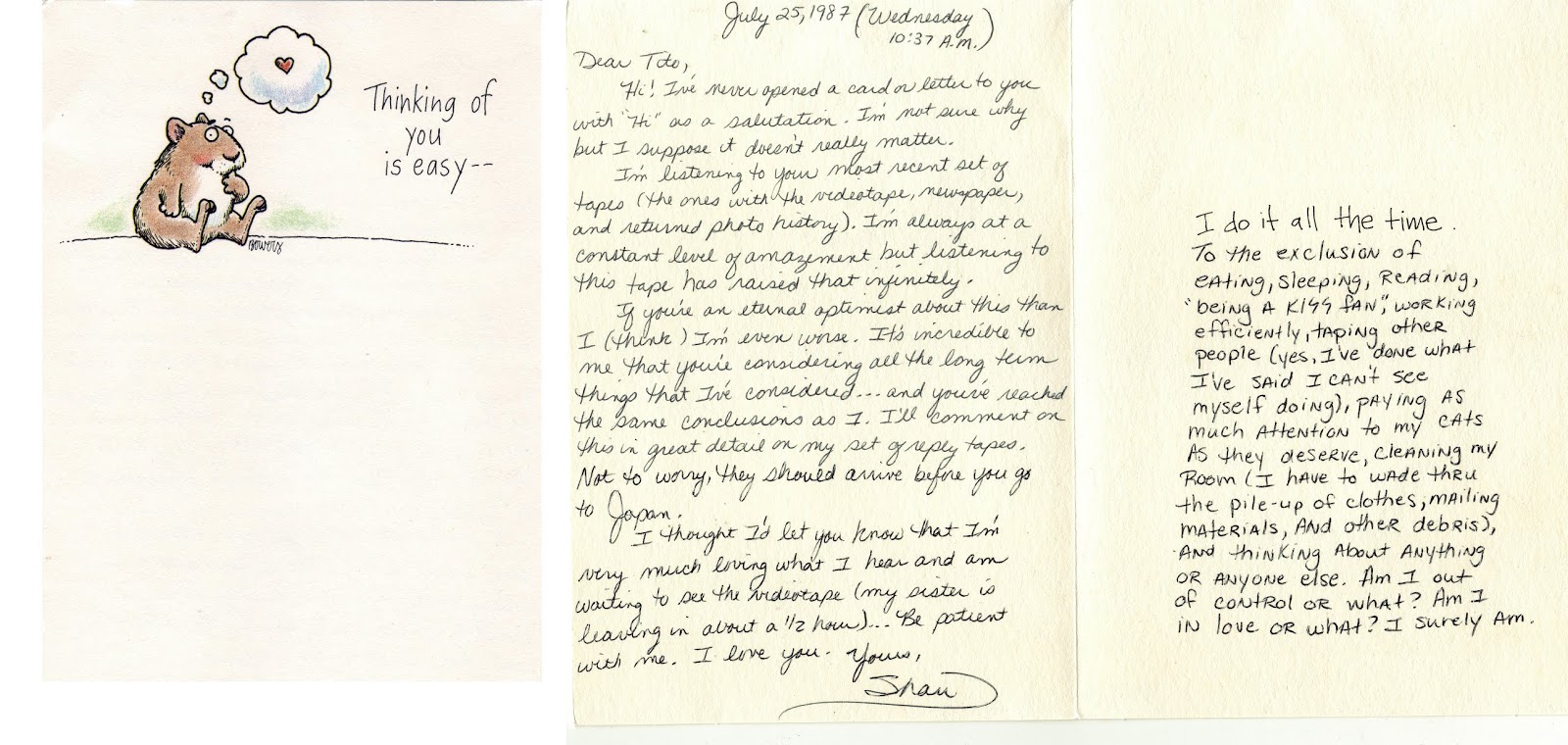
I never read those romance novels because I spent my time weaving my own fantasy worlds to escape reality. When Tito came along, I became obsessed with him and he became my default thought any time I wasn't occupied with work or other tasks. Our long distance relationship was where I imagined a better life. The main difference between my mother's obsession and mine was that mine carried the hope of turning into reality.
This card was written a week after Tito and I committed to our long distance relationship and details very well how preoccupied I was with him.
My mother was obsessed with paperback bodice rippers. The covers were always the same with minor variations. Manly men and womanly women who dressed in clothes that revealed their well-appointed bulges graced every tome. If you looked at their posture, there was always a sense that these strapping men were both protecting and dominating the women next to them.
I occasionally glanced at my mother as she spent hours reading these types of books. Her face registered more emotion while engaging with them than it ever did when dealing with her husband or children. She'd smile. Her eyebrows would arch. She'd look engaged or excited. She'd frown, which was the only expression from her that we shared with the books.
The books were my mother's obsession because they allowed her to live in a fantasy existence. She needed this to survive the harshness of her reality. If she was given the choice between living with poverty, an alcoholic husband, and the squalor of our home and envisioning herself as the comely servant woman who the handsome and wealthy lord of the manor fell in love with, she'd choose the latter.
I never read those romance novels because I spent my time weaving my own fantasy worlds to escape reality. When Tito came along, I became obsessed with him and he became my default thought any time I wasn't occupied with work or other tasks. Our long distance relationship was where I imagined a better life. The main difference between my mother's obsession and mine was that mine carried the hope of turning into reality.
This card was written a week after Tito and I committed to our long distance relationship and details very well how preoccupied I was with him.
Tuesday, February 4, 2020
Maximum Occupancy, and an enclosure with the July 9, 1987 greeting card
Bob handed me a bunch of files and asked me to review them. Each was a record of a mentally ill person currently taking up short-term residence on the psychiatric ward at the local hospital. I'd been in that ward once before for far more personal reasons, so the idea of going there again was intimidating.
The last time I'd gone there was about six months I'd gotten my job. I was working as an "arts counselor" at a Lutheran camp. The camp usually kept us locked in six days a week, but one Thursday, someone came and grabbed me and said I could leave. Since they were so Draconian about us staying on the grounds around the clock every day except Saturday and part of Sunday, I was confused about why they were letting me go.
My father was there waiting in his car for me. His explanation was brief and ambiguous. My mother was in the hospital and he wanted me to go there. Through some stilted exchanges, he let me know that she was in the car with him and became increasingly incoherent and drowsy. He'd seen her popping pain pills, but hadn't realized she'd gotten confused and was overdosing until she'd passed out.
He rushed her to the hospital and they told him that they thought she wasn't going to make it. Oddly, rather than stay with his dying wife, he got in a car and drove to the camp to get me. I guess this was just part of being a parentified child with parents who couldn't face adult responsibilities.
When I got to the hospital, the doctors took me into an emergency room where my mother's eyes were open and blank and she was constantly having small seizures. Her body's twitching was the only sign of life in her. As I stood there looking shocked, the doctor told me to shout to her as that sometimes helped people who were on the brink come back. My dad stood back looking uncomfortable and helpless.
I walked up to my mother's twitching body and started yelling "Mom, we love you, come back!" I kept shouting and my dad weekly started saying her name somewhat loudly, but it was clear that he was fighting discomfort and vaguely following my lead. My mother kept seizing with dead eyes and showed no reaction to either of us. After a few minutes, the doctor said we should move along to the waiting room and we would have to wait and see if she recovered or died.
My mother pulled through, and the doctor said he felt it was because of what I did because he expected she wouldn't make it with the level of drugs in her body. After this experience, a psychiatrist from the hospital came by to talk to both my mother and me. He told both of us that he felt she needed a place where she could just relax and get away from her stresses for about a week before returning home. I think he had spoken to her first and she'd revealed some of the hardships of her life to him.
He pressured both of us to have her spend time in the psychiatric ward. I confirmed with him that this was just about getting her some rest and nothing else. He said that was so, but when we went to the ward, it was behind a locked door and her room was locked as well. There were hangers that were welded into the closet and nothing in the room with which she could hurt herself. It was clear that he believed her overdose was intentional and she'd tried to kill herself. My mother became increasingly freaked out by the rubber-room-feel of the space and begged me not to make her stay there.
Since it was clear that we'd been tricked, I told the psychiatrist that we'd changed our minds. She didn't want to stay there and I wasn't going to force her to do so. He argued with me calmly at first, but became angry and started shouting at me when I didn't back down. In the end, he told me that it would be on my head if she killed herself as he was certain she was a suicide risk.
My mother hadn't tried to kill herself and, in fact, refused to take any strong pain medication after this incident. One of my cousins told me that she'd noticed some signs of confusion in my mother before this happened. She said she'd noticed my mother trying to eat, but sometimes struggling to hit her mouth because she was clearly over-medicated. I wished she'd told me about this before my mother nearly died.
About eight months after this incident, I took my pile of files from Bob and went to that very same local psychiatric ward. This time, I was there to interview people whose families committed them to see if they were ready to leave the locked rooms and ward and move into our halfway house's residential program. There were certain criteria that people had to meet to get in, and I had to assess them. When I arrived, one of the first people I saw was the psychiatrist who'd tried to browbeat me into keeping my mother in the ward. He looked at me quizzically, but didn't seem to connect me with what had happened. He just knew he'd seen me before.
I conducted interviews at that ward on a fairly regular basis because we needed to fill any empty slots in the halfway houses. We got money from the state and county for each bed that was occupied. On July 9, 1987, I got a copy of a letter from the board of directors telling us we had to first have full occupancy before we could get a raise in our salaries. It's important to note that we weren't well-paid. Many of our workers with children qualified for food stamps because their income fell below the poverty threshold for a family of a certain size.
I sent a copy of that letter with my angry comments to Tito. Note that the non-profit that I worked for has been out of commission for decades now and that is why I am allowing the real name on the document.
The last time I'd gone there was about six months I'd gotten my job. I was working as an "arts counselor" at a Lutheran camp. The camp usually kept us locked in six days a week, but one Thursday, someone came and grabbed me and said I could leave. Since they were so Draconian about us staying on the grounds around the clock every day except Saturday and part of Sunday, I was confused about why they were letting me go.
My father was there waiting in his car for me. His explanation was brief and ambiguous. My mother was in the hospital and he wanted me to go there. Through some stilted exchanges, he let me know that she was in the car with him and became increasingly incoherent and drowsy. He'd seen her popping pain pills, but hadn't realized she'd gotten confused and was overdosing until she'd passed out.
He rushed her to the hospital and they told him that they thought she wasn't going to make it. Oddly, rather than stay with his dying wife, he got in a car and drove to the camp to get me. I guess this was just part of being a parentified child with parents who couldn't face adult responsibilities.
When I got to the hospital, the doctors took me into an emergency room where my mother's eyes were open and blank and she was constantly having small seizures. Her body's twitching was the only sign of life in her. As I stood there looking shocked, the doctor told me to shout to her as that sometimes helped people who were on the brink come back. My dad stood back looking uncomfortable and helpless.
I walked up to my mother's twitching body and started yelling "Mom, we love you, come back!" I kept shouting and my dad weekly started saying her name somewhat loudly, but it was clear that he was fighting discomfort and vaguely following my lead. My mother kept seizing with dead eyes and showed no reaction to either of us. After a few minutes, the doctor said we should move along to the waiting room and we would have to wait and see if she recovered or died.
My mother pulled through, and the doctor said he felt it was because of what I did because he expected she wouldn't make it with the level of drugs in her body. After this experience, a psychiatrist from the hospital came by to talk to both my mother and me. He told both of us that he felt she needed a place where she could just relax and get away from her stresses for about a week before returning home. I think he had spoken to her first and she'd revealed some of the hardships of her life to him.
He pressured both of us to have her spend time in the psychiatric ward. I confirmed with him that this was just about getting her some rest and nothing else. He said that was so, but when we went to the ward, it was behind a locked door and her room was locked as well. There were hangers that were welded into the closet and nothing in the room with which she could hurt herself. It was clear that he believed her overdose was intentional and she'd tried to kill herself. My mother became increasingly freaked out by the rubber-room-feel of the space and begged me not to make her stay there.
Since it was clear that we'd been tricked, I told the psychiatrist that we'd changed our minds. She didn't want to stay there and I wasn't going to force her to do so. He argued with me calmly at first, but became angry and started shouting at me when I didn't back down. In the end, he told me that it would be on my head if she killed herself as he was certain she was a suicide risk.
My mother hadn't tried to kill herself and, in fact, refused to take any strong pain medication after this incident. One of my cousins told me that she'd noticed some signs of confusion in my mother before this happened. She said she'd noticed my mother trying to eat, but sometimes struggling to hit her mouth because she was clearly over-medicated. I wished she'd told me about this before my mother nearly died.
About eight months after this incident, I took my pile of files from Bob and went to that very same local psychiatric ward. This time, I was there to interview people whose families committed them to see if they were ready to leave the locked rooms and ward and move into our halfway house's residential program. There were certain criteria that people had to meet to get in, and I had to assess them. When I arrived, one of the first people I saw was the psychiatrist who'd tried to browbeat me into keeping my mother in the ward. He looked at me quizzically, but didn't seem to connect me with what had happened. He just knew he'd seen me before.
I conducted interviews at that ward on a fairly regular basis because we needed to fill any empty slots in the halfway houses. We got money from the state and county for each bed that was occupied. On July 9, 1987, I got a copy of a letter from the board of directors telling us we had to first have full occupancy before we could get a raise in our salaries. It's important to note that we weren't well-paid. Many of our workers with children qualified for food stamps because their income fell below the poverty threshold for a family of a certain size.
I sent a copy of that letter with my angry comments to Tito. Note that the non-profit that I worked for has been out of commission for decades now and that is why I am allowing the real name on the document.
Subscribe to:
Posts (Atom)